
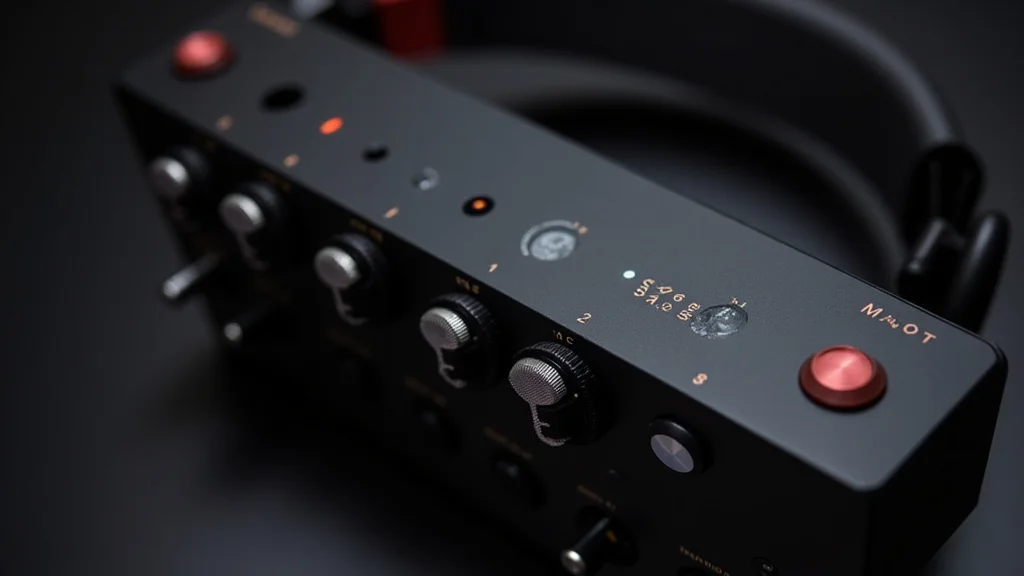
Many folks hear the term headphone amplifier and think it sounds complicated. It can seem like something only audio experts need. But it’s actually a pretty straightforward tool that can make your music sound way better.
If you’re new to this, don’t worry! We’ll break it all down step-by-step. Get ready to learn how to get the best sound from your headphones.
Key Takeaways
- A headphone amplifier boosts the audio signal for better sound quality.
- They can make quiet music louder and clearer.
- Headphone amplifiers help headphones perform at their best.
- Choosing the right amplifier depends on your headphones and listening habits.
- Portable and desktop options offer different advantages.
- Even simple setups can benefit from an amplifier.
What Is A Headphone Amplifier
A headphone amplifier is a device that takes a weak audio signal and makes it stronger. Think of it like a volume knob, but for the quality of the sound, not just how loud it is. When your music player, like a phone or computer, sends audio to your headphones, the signal can sometimes be too weak.
This is especially true for high-quality or high-impedance headphones, which need more power to sound their best. A headphone amplifier steps in to provide that extra power, cleaning up the signal and making your music richer, more detailed, and more dynamic.
Why You Might Need One
You might need a headphone amplifier if you notice a few things with your current setup. Perhaps your music sounds a bit too quiet, even when you turn your device’s volume all the way up. Maybe you hear a lot of background noise or a fuzzy sound, especially at lower volumes.
High-fidelity headphones, often called “audiophile” headphones, are designed to reproduce every nuance of a recording. However, they often require more power than standard portable devices can provide. Without enough power, these headphones can sound flat, lack bass, or simply not live up to their potential.
An amplifier makes sure your headphones are getting the strong, clean signal they need to perform beautifully.
Headphone Amplifier Power Explained
The power output of an audio source, like a smartphone, is usually measured in milliwatts (mW). Different devices have different power outputs. For example, a typical smartphone might output around 10-50 mW per channel.
This is often enough for basic earbuds or lower-impedance headphones (those with lower resistance, measured in ohms). However, higher-impedance headphones (often 100 ohms or more) can require significantly more power, sometimes 100 mW or even several hundred milliwatts, to reach enjoyable listening levels and sound their best. Without sufficient power, the amplifier in your phone or computer might struggle, leading to distortion, a lack of dynamic range, and a generally unsatisfying listening experience.
- Signal Boosting: The primary job is to increase the amplitude of the audio signal. This means making the electrical waves that represent sound bigger and stronger.
- Impedance Matching: Amplifiers are designed to work well with different headphone impedances. They provide the right voltage and current to drive headphones effectively.
- Reduced Distortion: By providing a clean, powerful signal, an amplifier helps prevent distortion that can occur when a source device is pushed to its limits.
- Improved Dynamic Range: This refers to the difference between the loudest and quietest parts of the music. An amplifier can help reveal more detail in both.
- Better Bass Response: More power can lead to tighter, more controlled, and more impactful bass.
Types Of Headphone Amplifiers
Headphone amplifiers come in various shapes and sizes, catering to different needs and budgets. The main distinction is often between portable and desktop amplifiers. Portable units are designed for use on the go, fitting easily into a pocket or bag.
They are typically battery-powered and connect to your smartphone, DAP (Digital Audio Player), or laptop. Desktop amplifiers, on the other hand, are usually larger, powered by an AC wall adapter, and are meant for use at a desk or home. They often offer more power and features than their portable counterparts.
Portable Headphone Amplifiers
Portable headphone amplifiers, often called “headphone amps” or “portable DAC/amps” (since many also include a Digital-to-Analog Converter), are fantastic for anyone who listens to music while commuting, traveling, or just moving around. They are small and lightweight, making them easy to carry. Many connect directly to your phone or other device via USB or Bluetooth.
These devices are great for giving your earbuds or portable headphones a significant audio upgrade without adding much bulk. Some higher-end portable amps are even designed to sound as good as many desktop units, offering a great balance of portability and performance.
- Compact Size: Designed to be carried easily in a pocket or small bag.
- Battery Powered: Rely on internal rechargeable batteries for power.
- Versatile Connectivity: Often connect via USB, Lightning, or Bluetooth to source devices.
- Convenience: Ideal for improving audio quality on the go.
- Cost Effective: Can be a more budget-friendly entry point into better audio.
Desktop Headphone Amplifiers
Desktop headphone amplifiers are the workhorses for home listening. They are typically plugged into a wall outlet for continuous power, meaning they can deliver more consistent and higher levels of power than portable units. This makes them essential for driving demanding, high-impedance headphones.
Desktop amps often offer a wider range of connectivity options, including RCA inputs for connecting to dedicated audio players or DACs, and sometimes balanced outputs for even cleaner sound. They can also feature more advanced circuitry and components, leading to superior sound reproduction and features like multiple headphone outputs.
- Higher Power Output: Capable of driving even the most power-hungry headphones.
- AC Powered: Rely on wall power for consistent, high-level performance.
- Advanced Features: May include DACs, multiple inputs/outputs, and tone controls.
- Superior Sound Quality: Often built with higher-grade components for audiophile-level sound.
- Stationary Use: Best suited for a fixed listening setup at home or in an office.
Headphone Amplifier DAC Combos
Many modern headphone amplifiers, especially portable ones, include a built-in Digital-to-Analog Converter (DAC). A DAC is what converts the digital audio files from your phone or computer into an analog signal that your headphones can understand. When a DAC and amplifier are combined into a single unit, it’s often called a DAC/amp.
This combination is very convenient because it simplifies your audio chain. Instead of needing a separate DAC and amplifier, you have one device that handles both tasks. This can also lead to better synergy between the components, as they are designed to work together.
For many users, a good DAC/amp is all they need to get a significant audio upgrade.
- Integrated Solution: Combines two essential audio components into one device.
- Simplified Setup: Reduces the number of cables and devices needed.
- Potential for Better Performance: Components are engineered to work in harmony.
- Cost Savings: Often more affordable than buying separate DAC and amplifier units.
- Convenience: Streamlines your audio system for easier use.
Benefits Of Using A Headphone Amplifier
The primary benefit of using a headphone amplifier is a noticeable improvement in sound quality. This can manifest in several ways, making your listening experience more immersive and enjoyable. It’s not just about making things louder; it’s about revealing details and dynamics that you might not have heard before.
For anyone serious about their audio, a headphone amplifier is often considered an essential part of the chain. It allows your headphones, especially higher-end models, to perform at their absolute best. This can transform casual listening into a truly engaging experience.
Improved Audio Clarity And Detail
One of the most significant advantages of a headphone amplifier is enhanced audio clarity. When a source device’s built-in amplifier struggles to provide enough power, the audio signal can become muddy or distorted. An external amplifier, with its dedicated circuitry, can deliver a cleaner, more precise signal.
This allows subtle details in the music, like the pluck of a guitar string, the breath of a singer, or the resonance of a drum, to come through with much greater definition. You’ll hear instruments separated more distinctly and textures that were previously masked.
- Separation of Instruments: Each instrument or vocal can be heard more distinctly.
- Revealing Nuances: Finer details in the recording become apparent.
- Reduced Harshness: A clean signal can make treble less sibilant or piercing.
- Improved Soundstage: The perceived “space” where the music is happening feels larger and more defined.
- Overall Fidelity: The sound reproduction is closer to what the artist and engineer intended.
Enhanced Bass Response
Headphones, especially those with larger drivers, often have the potential for deep, impactful bass. However, without sufficient power, this bass can sound weak, boomy, or undefined. A headphone amplifier provides the necessary current and voltage to properly control the headphone drivers.
This results in tighter, more accurate bass that has more punch and impact. Instead of a generalized rumble, you can experience the subtle textures and rhythms within the low frequencies, adding a new dimension to genres like electronic music, rock, and hip-hop. This improved bass response makes music feel more alive and engaging.
- Tighter Bass: Low frequencies are more controlled and less muddy.
- Greater Impact: Bass notes have more punch and physical presence.
- Better Texture: Subtle variations in bass lines become audible.
- Dynamic Range in Lows: The difference between loud and quiet bass is more pronounced.
- Foundation of Music: A strong bass foundation makes the entire track feel more complete.
Driving High-Impedance Headphones
High-impedance headphones are a particular favorite among audiophiles because they often offer superior sound quality, clarity, and detail. However, their high impedance means they require more voltage to reach a listening volume. Many portable devices and laptops simply cannot provide enough voltage to drive these headphones effectively.
This is where a headphone amplifier becomes indispensable. It provides the necessary voltage and power to make high-impedance headphones sing, allowing them to reveal their full sonic potential. Without an amplifier, these headphones might sound disappointingly quiet or thin.
For example, many Sennheiser HD 600 series headphones have an impedance of 300 ohms. A typical smartphone’s output is far too low to properly power them. You would need an amplifier capable of delivering hundreds of milliwatts at 300 ohms to get a good listening experience.
This power allows the drivers to move accurately and reproduce the full range of dynamics and detail that these headphones are capable of.
Choosing The Right Headphone Amplifier
Selecting the right headphone amplifier involves considering your existing equipment and listening habits. It’s not a one-size-fits-all situation. The most crucial factors are the impedance and sensitivity of your headphones, your primary listening source, and where you’ll be using the amplifier.
A powerful amplifier might be overkill for sensitive earbuds, while a weak amplifier won’t be able to drive demanding headphones. Think about your headphones’ requirements first, then match them with an amplifier that meets those needs while fitting your lifestyle.
Matching Amplifiers To Headphones
The most important aspect of choosing an amplifier is to match it with your headphones. Headphones have a rating for impedance, measured in ohms (Ω), and sensitivity, measured in decibels per milliwatt (dB/mW) or decibels per volt (dB/V). Headphones with low impedance (below 50 Ω) are generally easier to drive and can often be powered sufficiently by portable devices or lower-power amplifiers.
Headphones with high impedance (above 100 Ω, and often 250 Ω or 300 Ω) require more voltage to achieve adequate volume and sound their best. You need an amplifier that can supply this voltage without straining. Check the specifications of your headphones and look for an amplifier that can comfortably meet or exceed their power requirements, especially for high-impedance models.
- Low Impedance Headphones: (<50 Ω) Usually don't need a powerful external amplifier, but an amp can still improve clarity.
- Medium Impedance Headphones: (50-150 Ω) May benefit from a moderate-power amplifier, especially from portable sources.
- High Impedance Headphones: (>150 Ω) Almost always require a dedicated, higher-power amplifier to sound their best.
- Sensitivity: Low sensitivity headphones (lower dB/mW) require more power to reach the same volume as high sensitivity headphones.
- Manufacturer Recommendations: Always check your headphone manufacturer’s specs and consider recommendations for amplifiers.
Source Device Considerations
The device you use to play your music (your source) plays a big role in amplifier choice. If you primarily listen from a smartphone or tablet, a portable DAC/amp is usually the best bet. These devices connect directly to your phone, bypassing its internal, often less capable, audio circuitry.
If you use a computer, you might opt for a USB DAC/amp or a desktop amplifier connected to your computer’s audio output. Some high-end audio players (DAPs) have excellent built-in amplifiers, and you might only need a simple DAC or even no external amplifier at all if you are using moderate-impedance headphones.
Portability vs. Desktop Use
Your listening environment dictates whether a portable or desktop amplifier is more suitable. If you travel frequently, commute, or work in different locations, a portable unit is ideal. It’s compact, battery-powered, and can easily slip into your bag.
For dedicated listening sessions at home or in a home office, a desktop amplifier often provides superior performance due to its higher power output and potentially more sophisticated circuitry. Desktop units don’t need to worry about battery life and can be designed for maximum audio fidelity. Some users even have both – a portable amp for on-the-go and a more powerful desktop setup for home.
How To Connect A Headphone Amplifier
Connecting a headphone amplifier is generally straightforward. The process will vary slightly depending on whether you have a portable unit or a desktop setup, and the specific inputs and outputs available on your devices. The goal is always to get the best possible audio signal from your source device to your amplifier, and then from the amplifier to your headphones.
Connecting A Portable Amplifier
Portable headphone amplifiers typically connect to your source device (like a smartphone, tablet, or laptop) in one of a few ways. The most common is via a USB cable. You’ll plug one end into your source device and the other into the amplifier.
Many portable amps also support Bluetooth for wireless convenience, though wired connections usually offer better sound quality. Once connected, you simply plug your headphones into the headphone output jack on the amplifier. Make sure your source device is set to output audio to the connected amplifier (this often happens automatically, but you might need to select it in settings).
- Connect to Source: Use a USB cable (or sometimes a 3.5mm audio cable or Bluetooth) to connect the amplifier to your phone, tablet, or computer.
- Connect Headphones: Plug your headphones into the headphone jack on the amplifier.
- Set Source Output: Ensure your source device is set to send audio to the amplifier (check settings if necessary).
- Adjust Volume: Use the volume control on the amplifier, not your source device, for optimal sound.
Connecting A Desktop Amplifier
Desktop headphone amplifiers often connect to your source using RCA cables, optical cables, or USB. If you’re connecting to a computer, a USB cable is common, effectively making the amplifier an external sound card. If you have a dedicated audio player or receiver, you might use RCA cables to connect the pre-out or line-out signal to the amplifier’s input.
Some desktop amplifiers include a built-in DAC, so they connect directly via USB from your computer. Again, once the amplifier is connected to your source, you plug your headphones into the amplifier’s headphone jack. For desktop setups, it’s often best to use the amplifier’s volume control exclusively.
- Source Input: Connect your source (computer, CD player, etc.) to the amplifier’s input jacks (e.g., RCA, USB, optical).
- Headphone Output: Plug your headphones into the amplifier’s designated headphone jack.
- Power Up: Ensure both the source and amplifier are powered on.
- Volume Control: Use the amplifier’s volume knob for listening level adjustments.
Common Myths Debunked
There are a lot of misconceptions about headphone amplifiers. Some people think they are only for professional musicians or that they are overly complicated and expensive. Let’s clear up some of these common myths so you can feel confident about whether one is right for you.
Myth 1: Headphone Amplifiers Are Only For Loud Music
This is not true. While amplifiers can certainly make music louder, their primary benefit is improving sound quality. They help reveal subtle details, improve clarity, and tighten bass, making quiet passages in music more enjoyable and nuanced.
A good amplifier can make a delicate acoustic piece sound more impactful and detailed, not just louder.
Myth 2: All Headphone Amplifiers Are Expensive
While high-end amplifiers can certainly cost a lot, there are many affordable options available, especially for portable use. Entry-level portable DAC/amps can be found for under $50, offering a noticeable improvement over a smartphone’s built-in audio. Even some well-regarded desktop units are quite reasonably priced, making better audio accessible to more people.
Myth 3: You Need Expensive Headphones To Benefit From An Amplifier
While high-impedance or high-fidelity headphones show the most dramatic improvements, even moderately priced headphones can benefit. An amplifier provides a cleaner signal, which can reduce distortion and improve clarity across a wide range of headphones. You might not get the same level of transformation as with top-tier headphones, but the difference can still be significant and make your existing headphones sound better.
Myth 4: Headphone Amplifiers Are Complicated To Use
For the most part, headphone amplifiers are very simple to operate. The connection process is usually just plugging in a few cables. The main control is typically a volume knob.
Many modern units, especially portable DAC/amps, are designed for plug-and-play simplicity, requiring no special software or complex setup.
Frequently Asked Questions
Question: Will a headphone amplifier make my music sound louder?
Answer: Yes, a headphone amplifier increases the audio signal strength, which can make your music sound louder. However, its main benefit is improving sound quality by providing more detail, clarity, and better bass response.
Question: Do I need a separate DAC if my amplifier has one?
Answer: No, if your headphone amplifier includes a built-in DAC (making it a DAC/amp), you do not need a separate DAC. The combined unit handles both digital-to-analog conversion and amplification.
Question: Can I use a headphone amplifier with my earbuds?
Answer: Yes, you can use a headphone amplifier with earbuds. While less demanding than larger headphones, some earbuds can still benefit from a cleaner, more powerful signal, especially if your source device has weak audio output.
Question: How do I know if my headphones are too difficult for my phone to drive?
Answer: If your music sounds quiet even at maximum volume, lacks bass, or sounds distorted when you try to turn it up, your headphones might be too difficult for your phone to drive. High impedance (over 100 ohms) is a common indicator.
Question: Should I use my phone’s volume or the amplifier’s volume?
Answer: For the best sound quality and to avoid distortion, it’s generally recommended to set your source device’s volume to a high level (e.g., 75-90%) and use the headphone amplifier’s volume control to adjust your listening level.
Conclusion
A headphone amplifier is a valuable tool for anyone looking to get more from their audio experience. It boosts sound quality, enhances detail, and provides cleaner, more powerful audio. Whether you choose a portable unit for on-the-go listening or a desktop amp for home, the benefits are clear.
Matching the amplifier to your headphones and source is key for optimal performance.